I’ve just finished writing a 150 word (ouch) proposal for a conference presentation and another for a virtual curation project (more about that if it progresses). I’m about to read a draft proposal for an event in which I might be collaborating later this year, And just before the end of last term I managed to squeeze my research proposal in to two sides of A4… Life is suddenly full of proposals! They are interesting things, a bit like fishing lures, colourful, buoyant, designed to have a tasty chunk of bait (appropriate to the kind of big fish one is trying to land) and a nice sharp hook with which to snag the prey, but dangled into murky waters in which one might be confidently swimming or nervously floundering! 

You can see my RD1 proposal here. I wonder what I’ll be thinking about it in a year’s time!

I tend to explain my project in such enthusiastic detail that people’s eyes glaze over (at least I notice when they begin to snore)! So I need to take note of this:Image


I borrowed this from Innovation for Growth!

In my never-ending search for illumination of things nineteenth century-ish , today I visited Leeds’ Abbey House museum. It was a pleasant, interesting experience, and the museum displays, which are of the reconstructed “Victorian street” variety, are good.

But my overwhelming impression was one of gloom. The exhibits are surrounded by a gloom that is so dense as to be sepulchral! At the same time one is not allowed to use flash, essentially ruling out hand-held photography. This is explained as necessary because of “conservation” requirements.

The Victorian period was as dull or bright as any other. Of course, at night, and without modern electrical lighting, streets and interiors were less well lit than we are accustomed to, but during the day, unless light was deliberately restricted, rooms would have been as bright as today. Sadly, the schoolchildren with whom I shared the museum (and perhaps most visitors) will come away from this museum believing that VIctorian times were universally dark, miserable and dingy.

And would flash photography damage the objects on show? The general consensus is no. It would require millions of strong UV flashes at close range to damage sensitive museum exhibits such as watercolour paintings. Small camera and phone flashguns are not going to do any damage, The Abbey House museum is visited by mere scores of people on a winter’s day, only a few of whom will use flash. The flash photography issue is apparently a self-perpetuating curatorial myth!

Of course, flashguns popping everywhere can annoy and disturb other visitors. Every photographer should take care not to lessen the enjoyment of others. However if the ambient lighting was increased, then it wouldn’t be necessary to use flash anyway. Perhaps over many decades this light might damage the pigments in objects, but these are not one-off national-treasure artworks. They are mass-produced “everyday” objects often created to brighten people’s lives, not hide in some ill-lit, shadowy corner. Surely we deserve to see these objects as they were meant to be enjoyed?

I spent a few hours today studying in the University of Leeds Brotherton Library. It’s a very different experience to MMU. No lifts loudly and endlessly announcing the floor numbers. The quiet study area was…wait for it…quiet! The books very well-worn. The atmosphere, slightly over-warm, but studious! Eccentric lighting between the stacks.

It’s a cylindrical 1930 building, so the book racks are spread out like the spokes of a wheel, which is both fun and confusing, especially when one is looking for the way out! I was instantly comfortable, though I was being stared at continuously by a young lady half a dozen desks away. Whether this was because of my boyish charm or she was actually looking at the young man working at the desk behind me I didn’t discover.

Getting my SCONUL card was effortless, and I walked out with four useful tomes. I also discovered a real gem, a reference to the Handbook of the Daily News Sweated Industries’ Exhibition of 1906, which I was then able to download as a pdf from the Smithsonian library.

This unlikely-sounding volume contains a number of photographs of working class interiors which will be hugely useful in the coming months. They appear to confirm something I’ve been mulling over recently – the difference between working-class life as reported by observers (who often had political, religious or aesthetic axes to grind) and the reality of everyday life for many.

The interiors, though of small rooms, nevertheless show a reasonable amount of furniture and, importantly for my thesis, varying numbers of ornaments ranged on mantelpieces and shelves. One illustration that particularly demonstrates this, of two women making cardboard boxes against a background that includes two shelved crowded with bric-a-brac, is above text that describes a box maker living in “two wretched rooms.” Yes, life was hard, homes were often also overcrowded workplaces, but it seems that many working-class people collected non-utilitarian objects to decorate their lives. Grist to my mill!

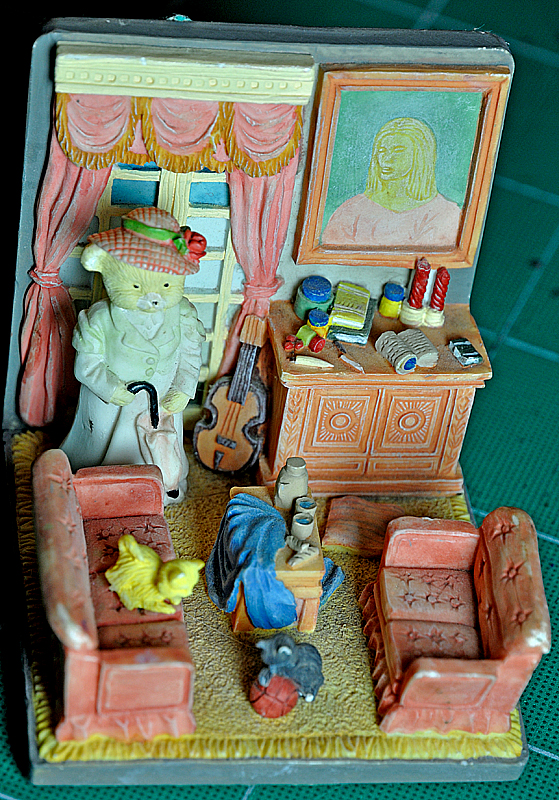
I could write an entire paper on just this single miniature!

Image

I spend four days this last week at a conference – the Society for Historical Archaeology annual conference in Leicester. These conferences are normally held in the United States, so it was good to be able to attend at minimal expense. I signed up as a student volunteer, so gained access to as many sessions as I wished for free, in return for eight hours volunteering.

The way the conference is organised is interesting and frustrating. There are always at least four sessions going on at once, with each presentation timed in parallel, so that you can, in theory, move from session to session in order to hear presentations that particularly interest you. Of course, speakers often overran their allotted 20 minutes, so presentations were often given against a background of people leaving and entering and crashing about, occasionally drowning the words. The sessions, which are usually four hours long, don’t allow questions until after the last speaker, which means that there is rarely any real discussion as one has usually forgotten the content of the first speaker’s presentation anyway!

Almost all the presentations I wanted to hear clashed with equally interesting papers, which was very frustrating, and I sometimes sat listening to one dull speaker and wishing I’d chosen to go to a different session instead!

As an impecunious student I couldn’t afford to attend the expensive paid-for workshops, tours and social events, but I did nevertheless hear some useful presentations and meet some great people. And I picked up a long list of abstracts and names that might be of use in the near future.

The research presented was sometimes rather dull, some of it pointless, and little was really inspiring, so I left feeling positive and excited about my own topic.

I also witnessed a wide range of presentation skills, from abysmal to entertaining! This was encouraging, as I realised that my own level is somewhere in the middle, and though it needs work, it hasn’t as far to go as that of some!

Next year’s conference is to be held in Quebec city, Canada, and I’m definitely going to see if I can present a paper at that meeting.

The words (approximately) of academic Donna Haraway as reported by one of her students who considered her work (the student’s) “important,” which I guess we all do to a certain extent, or why would we give over so much of our life, time and efforts to an activity as vacuous as research instead of, well, having fun doing other stuff:

“…what’s with this ‘important’ shit? Important will not see you through the writing of a dissertation or the living of a scholarly life; but what incites and interests you will.”

I like that.

It’s not often I read a non-fiction book straight through, but I’ve just demolished my copy of Bill Brown’s 2003 A Sense of Things, The Object Matter of American Literature, which now sprouts a forest of page-markers. The book has given me lots to think about, lit some light-bulbs, sent me scurrying after other references, got me to download a couple of nineteenth century pdfs (ah the joys of technology…to be able to sit in one’s sick-bed, accessing 150-year-old volumes in US university libraries).

I was already exploring Mark Twain’s writings about bric-a-brac, but Brown has alerted me to others, including Henry James, who has provided me with lots of interest. Brown points out that although some of James’ characters share a hatred of bric-a-brac, they also demonstrate that even “hideous objects could be loved.” As Brown writes: “…we use physical objects to arouse and organize our affection.” Yes!

Now I’m several chapters into Things, which Brown edited in 2004. This of course is more of a dipping-into read, but still valuable.

This almost-ended term we’ve been mulling over “New Journalism” or perhaps “New Writing” or perhaps Kurt Vonnegut’s writing (Vonnegut sticks in my admiring memory as the only writer I know to publish—several times—a sketch of his own anus and to describe the purpose of a novel as being “to describe blow-jobs artistically”) or perhaps how to write long sentences containing equally long sections within parentheses or perhaps how to best annoy one’s thesis examiners or perhaps how to repeat words like “or” as many times as possible in the same paragraph or “New Lists” or “When is a list not a list?” or “New Writing Self Help Advice from a Famous Editor Without Using Full Stops” Full Stop.

Inspired, then, by the great writers of the recent past, I sit gloomily at my desk, stabbing my keyboard with my index fingers (I’m the fastest two-finger typist in the west), the tips of which are being fast eroded by years of friction, surrounded by a drift of balled-up aloe vera impregnated tissues, each the result of a vain attempt to mop up generous by-products of flu, man-flu, some vicious virulent virus that has slipped past my defences of liberal doses of vitamin C and alcohol. Note the use of “v” in that sentence and weep, as I am (by the way it is apparently a sign of writing failure to use parentheses, but a sign of writing success to ignore what people say about using parentheses. Similarly, I look forward to using “but” to begin a sentence soon.). I am being nagged by a deadline of the day before yesterday, yet can hardly see my display, let alone draw anything. Unambitious December sunlight is sidling in through the window.

 I need to pull together enough energy to drag myself up to Manchester tomorrow so that I may learn about literature reviews. I groan at the thought of reading anything other than the instructions on Lemsip™ cartons. But (yes!) nevertheless today I have managed so far to read two thoughtful articles on gun massacres, one on an Internet-thrilling orgy in China, one on the challenge to higher education of MOOCs (I wonder if we will soon have MOOPhDs, which regrettably sound rather like advanced degrees in dairy farming?). None of these will have any impact on my research, and even less on the task I need to complete to meet that deadline. I have checked Facebook twice, and Twitter once. The only emails I’ve received this morning have been advertisements. My nose is sore, despite liberal applications of lip balm, and I am even deafer than usual.

 Writing when feeling sorry for oneself is hideously tedious for one’s readers but great therapy, almost as good as paracetamol. Actually, I wonder if the urge to write is often strongest exactly when the author is feeling really miserable, when his lover has just run off with his best friend (I’ve found a good way to avoid this happening is to have no friends), or he’s sitting, about to be eviscerated by shrapnel, in a muddy trench during a WWI battle (again best avoided by being born well after the event). There, I’ve managed a three-part list! Or he is an alcoholic in terminal decline (ah, my hero Raymond Carver). Or he suspects, with only 33 months to go, that his PhD topic is rubbish, or at least not as earth-shattering and Nobel Prize-winning as he’d fantasised. Jejune. That’s a word I had to look up yesterday, in my book-scattered bed. In one of the works I shall be referring to in my literature review. It struck me as appropriate.


Sniff!

Yesterday I was standing amongst a coffee-cup clutching crowd in a meeting room foyer at Manchester Museum when a technician came around the corner wheeling a trolley on which sat a fox. A stuffed fox. Which stared glassy-eyed at the throng. The technician decided that pushing his cargo through the crowd might be a wrong move, and turned tail (yes, I know!).

I was at “Researching Material Culture”, a Morgan Centre Interdisciplinary Dialogue event. I’d already had a brief encounter with Rachel Hurdley, from Cardiff University, who I greeted as “the mantelpiece lady!” I’d previously discovered her work through her paper Dismantling mantelpieces: narrating identities and materializing culture in the home, because of course the objects I research were and are often displayed above the hearth. She gave a lively and energising presentation on “…the craft(iness) of organising materials” which she began by (re)organising us, her loth-to-be-organised audience!

There were also encounters with a fellow PhD student, one of my supervisors, a member of staff who admitted possessing a cupboard-full of bric-a-brac (which I was invited to investigate – yes!) and a couple of people who I’d met just a few days ago at the CHAT conference in York.

So it was natural that I should receive a flyer in the event delegate pack inviting me to a conference next July entitled…Encounters! The call for papers includes “Material encounters.”  I think I might have a go!