
I could write an entire paper on just this single miniature!
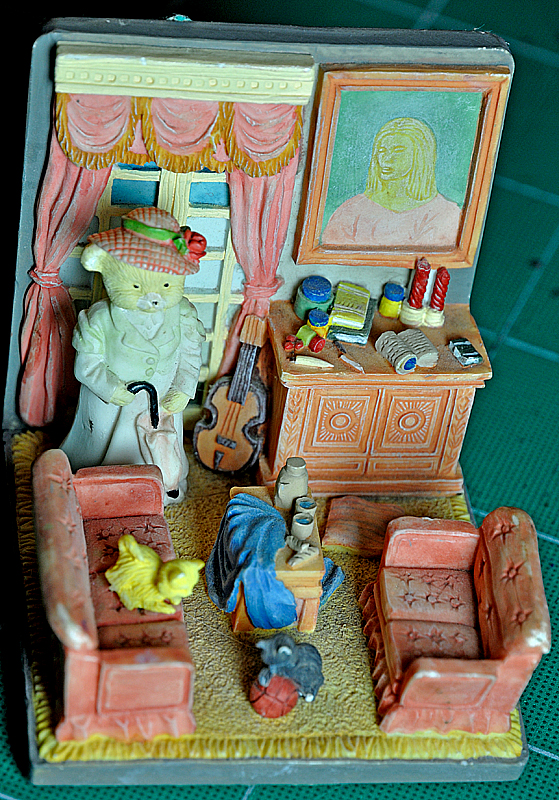
I could write an entire paper on just this single miniature!
I spend four days this last week at a conference – the Society for Historical Archaeology annual conference in Leicester. These conferences are normally held in the United States, so it was good to be able to attend at minimal expense. I signed up as a student volunteer, so gained access to as many sessions as I wished for free, in return for eight hours volunteering.
The way the conference is organised is interesting and frustrating. There are always at least four sessions going on at once, with each presentation timed in parallel, so that you can, in theory, move from session to session in order to hear presentations that particularly interest you. Of course, speakers often overran their allotted 20 minutes, so presentations were often given against a background of people leaving and entering and crashing about, occasionally drowning the words. The sessions, which are usually four hours long, don’t allow questions until after the last speaker, which means that there is rarely any real discussion as one has usually forgotten the content of the first speaker’s presentation anyway!
Almost all the presentations I wanted to hear clashed with equally interesting papers, which was very frustrating, and I sometimes sat listening to one dull speaker and wishing I’d chosen to go to a different session instead!
As an impecunious student I couldn’t afford to attend the expensive paid-for workshops, tours and social events, but I did nevertheless hear some useful presentations and meet some great people. And I picked up a long list of abstracts and names that might be of use in the near future.
The research presented was sometimes rather dull, some of it pointless, and little was really inspiring, so I left feeling positive and excited about my own topic.
I also witnessed a wide range of presentation skills, from abysmal to entertaining! This was encouraging, as I realised that my own level is somewhere in the middle, and though it needs work, it hasn’t as far to go as that of some!
Next year’s conference is to be held in Quebec city, Canada, and I’m definitely going to see if I can present a paper at that meeting.
The words (approximately) of academic Donna Haraway as reported by one of her students who considered her work (the student’s) “important,” which I guess we all do to a certain extent, or why would we give over so much of our life, time and efforts to an activity as vacuous as research instead of, well, having fun doing other stuff:
“…what’s with this ‘important’ shit? Important will not see you through the writing of a dissertation or the living of a scholarly life; but what incites and interests you will.”
I like that.
It’s not often I read a non-fiction book straight through, but I’ve just demolished my copy of Bill Brown’s 2003 A Sense of Things, The Object Matter of American Literature, which now sprouts a forest of page-markers. The book has given me lots to think about, lit some light-bulbs, sent me scurrying after other references, got me to download a couple of nineteenth century pdfs (ah the joys of technology…to be able to sit in one’s sick-bed, accessing 150-year-old volumes in US university libraries).
I was already exploring Mark Twain’s writings about bric-a-brac, but Brown has alerted me to others, including Henry James, who has provided me with lots of interest. Brown points out that although some of James’ characters share a hatred of bric-a-brac, they also demonstrate that even “hideous objects could be loved.” As Brown writes: “…we use physical objects to arouse and organize our affection.” Yes!
Now I’m several chapters into Things, which Brown edited in 2004. This of course is more of a dipping-into read, but still valuable.
This almost-ended term we’ve been mulling over “New Journalism” or perhaps “New Writing” or perhaps Kurt Vonnegut’s writing (Vonnegut sticks in my admiring memory as the only writer I know to publish—several times—a sketch of his own anus and to describe the purpose of a novel as being “to describe blow-jobs artistically”) or perhaps how to write long sentences containing equally long sections within parentheses or perhaps how to best annoy one’s thesis examiners or perhaps how to repeat words like “or” as many times as possible in the same paragraph or “New Lists” or “When is a list not a list?” or “New Writing Self Help Advice from a Famous Editor Without Using Full Stops” Full Stop.
Inspired, then, by the great writers of the recent past, I sit gloomily at my desk, stabbing my keyboard with my index fingers (I’m the fastest two-finger typist in the west), the tips of which are being fast eroded by years of friction, surrounded by a drift of balled-up aloe vera impregnated tissues, each the result of a vain attempt to mop up generous by-products of flu, man-flu, some vicious virulent virus that has slipped past my defences of liberal doses of vitamin C and alcohol. Note the use of “v” in that sentence and weep, as I am (by the way it is apparently a sign of writing failure to use parentheses, but a sign of writing success to ignore what people say about using parentheses. Similarly, I look forward to using “but” to begin a sentence soon.). I am being nagged by a deadline of the day before yesterday, yet can hardly see my display, let alone draw anything. Unambitious December sunlight is sidling in through the window.
I need to pull together enough energy to drag myself up to Manchester tomorrow so that I may learn about literature reviews. I groan at the thought of reading anything other than the instructions on Lemsip™ cartons. But (yes!) nevertheless today I have managed so far to read two thoughtful articles on gun massacres, one on an Internet-thrilling orgy in China, one on the challenge to higher education of MOOCs (I wonder if we will soon have MOOPhDs, which regrettably sound rather like advanced degrees in dairy farming?). None of these will have any impact on my research, and even less on the task I need to complete to meet that deadline. I have checked Facebook twice, and Twitter once. The only emails I’ve received this morning have been advertisements. My nose is sore, despite liberal applications of lip balm, and I am even deafer than usual.
Writing when feeling sorry for oneself is hideously tedious for one’s readers but great therapy, almost as good as paracetamol. Actually, I wonder if the urge to write is often strongest exactly when the author is feeling really miserable, when his lover has just run off with his best friend (I’ve found a good way to avoid this happening is to have no friends), or he’s sitting, about to be eviscerated by shrapnel, in a muddy trench during a WWI battle (again best avoided by being born well after the event). There, I’ve managed a three-part list! Or he is an alcoholic in terminal decline (ah, my hero Raymond Carver). Or he suspects, with only 33 months to go, that his PhD topic is rubbish, or at least not as earth-shattering and Nobel Prize-winning as he’d fantasised. Jejune. That’s a word I had to look up yesterday, in my book-scattered bed. In one of the works I shall be referring to in my literature review. It struck me as appropriate.
Sniff!
Yesterday I was standing amongst a coffee-cup clutching crowd in a meeting room foyer at Manchester Museum when a technician came around the corner wheeling a trolley on which sat a fox. A stuffed fox. Which stared glassy-eyed at the throng. The technician decided that pushing his cargo through the crowd might be a wrong move, and turned tail (yes, I know!).
I was at “Researching Material Culture”, a Morgan Centre Interdisciplinary Dialogue event. I’d already had a brief encounter with Rachel Hurdley, from Cardiff University, who I greeted as “the mantelpiece lady!” I’d previously discovered her work through her paper Dismantling mantelpieces: narrating identities and materializing culture in the home, because of course the objects I research were and are often displayed above the hearth. She gave a lively and energising presentation on “…the craft(iness) of organising materials” which she began by (re)organising us, her loth-to-be-organised audience!
There were also encounters with a fellow PhD student, one of my supervisors, a member of staff who admitted possessing a cupboard-full of bric-a-brac (which I was invited to investigate – yes!) and a couple of people who I’d met just a few days ago at the CHAT conference in York.
So it was natural that I should receive a flyer in the event delegate pack inviting me to a conference next July entitled…Encounters! The call for papers includes “Material encounters.” I think I might have a go!
Yesterday I gave my first-ever conference presentation (£0.99 archaeology. Small Things Considered at the 2012 Contemporary and Historical Archaeology in Theory conference in York).
It was a combination of fun and terror. I came at the end of the penultimate conference session, following two academics much more experienced in my field than I. But it went OK. The technology worked perfectly (a bugbear of mine). I decided halfway through to cut some of my text to avoid the session over-running – better to be concise that have people desperately waving papers bearing cryptic messages at you! The audiences laughed at the correct moments. They asked interesting questions, made useful suggestions and made no crushing comments. And afterwards I received some encouraging Tweets. So all in all, a positive experience. Now I know how to make my next presentation even better!
Phew! After a significant amount of blood sweat and tears, I have reduced my PhD proposal to the required two sides of A4 required for the first big chunk of form-filling, the dreaded RD1. It’s still at a draft stage, but I’m winning…
Not long after I emerged, blinking and proudly clutching my MA, I was asked to write a chapter based on my dissertation for a book on material culture. It was a bit of an emergency, the deadline was in a couple of months’ time (the other authors had had over a year), but it was also flattering to be asked and a publication would surely be good for my academic curriculum vitae.
So I bashed out my allotted word count, went through four drafts and sent it off. The editor trimmed some fat and made a few minor suggestions, and then the book went for review. A long time passed. I was able to refer to my chapter as “in review,” a good feeling.
And then the reviews came back. Today I learned that one reviewer had no comments at all, another noted in passing my scholarly parallels with Professor Paul Mullins of Indiana University, which is absolutely true, but the third, who waived anonymity and who I therefore know to be someone whose work I admire, had some pretty tough and searching things to say about a dozen aspects of my paper.
Now, I’ve always had to fight against a a sometimes overwhelming lack of self-worth. It’s a dark presence constantly looking over my shoulder and gripping at my vitals. I’ve usually managed to disguise it, to grit my teeth and push it back into the shadows, to choose deliberately activities that force me to the forefront, to lead as well as follow. To do all those things that cause a tightening of stomach muscles and a loosening of sphincters. So handling a review is a challenge.
My first reaction was, of course, despond. My chapter was rubbish, worthless, my scholarship crap, my writing terrible. Once again, here I was at the beginning of my PhD, something big and positive and fun, and here was a set-back making me doubt the whole idea, and myself! Groan!
But then I forced myself to think this through, bit by agonising bit. Firstly, only one of three reviewers thought to comment on my piece. Secondly, the article had satisfied the editor, a respected academic to whose field my work is very relevant. Thirdly, I realised that dealing with the reviewers comments will give me a chance to improve the piece. I recognise that the final version will be better once I have cleared up some confusions, sorted some rhetorical extravagances, got rid of some over-ambitious claims. Fourthly, I don’t have to agree with everything she says. Fifthly, the timing is good, in that it gives me another prompt to firm up, justify and clarify my thinking before I get into the nitty-gritty of three years of research.
And finally, the reviewer is a highly-respected career academic, a professor who has been working in this field for, what, 25 years or so. She has about 30 publications to her name.
By contrast, the totality of my academic experience is a one-year taught MA, during which I carried out a mere four months of research for my dissertation. I got a distinction and my dissertation won a prize. Perhaps I’ve done well to have got this far?
Still, I need a big glass of something strong and amber-coloured to fuel my next steps!
Our post-lecture discussion of the everyday led, circuitously, to everyday images. At one point I mentioned my sense of loss resulting from the disappearance, in the midst of one of life’s traumatic upheavals, of most of my collection of 35mm colour transparencies, which dated back as far as my teens and included my undergraduate days, much of my archaeology career, a handful of exes, some travels and much besides.
I have clear memories of many of the images on those transparencies, memories which of course include not only the “frozen moment” captured on Agfacolor or Ektachrome but different snatches of time either side of that fossilised 60th of a second at f8. Are those memories different to the image? Better than the image? An extension of the image? Or are they somehow lessened by the lack of something tangible to which to anchor them?
Bob told of a photograph, an only print now destroyed, of his father holding him when he was a child. He feels that his memory of the image is so strong and clear that he doesn’t need the snapshot to recall it and the importance of what it depicted.
Yet I, despite being able to describe to you many of those lost-for-ever photographs, nevertheless continue to mourn their destruction. Perhaps as an over-reaction I now keep my last 20 years-worth of photographic negatives in a safety deposit box, and back up my digital images not just once but thrice, with one hard drive locked away in the same deposit box!
The importance of the physicality of photographs is surely demonstrated by people’s defacement of them, by the almost violent excision of a no-longer-loved one, the scratching or obliteration of a despised face, the almost-ritual tearing up of photographs of an ended relationship, the turning of a photograph to the wall…
This ramble is all very shallow, and I know many have thought hard and written copiously about what photography is and does. So I have to look much more deeply into the relationship between memory and memento, and remembered and tangible images, for the three-dimensional objects I am researching were often called “images” in the nineteenth century. They were also referred to as “figures,” echoing perhaps the use of the word to describe two-dimensional book illustrations as well as three dimensional human bodies.
 Miniature Material Culture